Curriculum Model
A broad, balanced and ambitious curriculum for all.
The curriculum model at Witton Park Academy is designed to bring to life a broad and balanced range of subjects and disciplines for all pupils. Our high-quality curriculum is knowledge- and skills-rich and focuses on the content learners need to increase their expertise in a given subject.
The curriculum aims to nurture pupils’ spiritual, moral, social, cultural, physical, and intellectual development; creating a desire and eagerness in all pupils to learn, regardless of their strengths, needs or starting points. Our curriculum emphasises the importance of developing essential and sequential knowledge and skills and focuses on learning and progress. We wish to best prepare our pupils for the pathways that lead to university, apprenticeships, meaningful employment and success in whatever further study or career pupils eventually choose. The curriculum at Witton Park Academy is intended to bring out the best in our pupils, leading them to achieve excellent results, which in turn increases their chances of being successful in higher education and future employment. It is our intention to guide pupils to be active and confident citizens who make a positive contribution to their communities and the wider world.
The curriculum at Witton Park Academy also reflects national policy and priorities, thus our pupils study courses that lead to the English Baccalaureate accreditation. All pupils study all statutory subjects. Alongside computing at KS3, our Google School status and our digital working methodologies further empowers our pupils to be technologically adept in a society which demands it.
We have high aspirations for all. Our Period 6 extended learning provision allows us to offer masterclasses for our pupils – with a particular focus on supporting our year 11s as they prepare for examinations. The period 6 – masterclass model also allows us to offer a range of clubs, extra curricular activities and enrichment opportunities for all pupils in years 7-11. Intervention, revision and achievement groups utilise time allocated in period 6 – providing support and additional learning opportunities for pupils in each year group.
Our current school timetable and curriculum model features 25 compulsory lessons per week, with 5 lessons each day. We offer an additional ‘period 6’ for masterclasses, scholarship programmes, enrichment and extracurricular activities as well as intervention and revision classes. Each lesson is 60 minutes in length. This model encourages pace and challenge in lessons, as well as providing the framework for a diverse and balanced curriculum offer for all our pupils. We have 5 morning tutor group sessions per week, each session is 20 minutes long and these take place Monday to Friday. These tutor sessions allow pupils to cover the RSE and PSHE curriculums, as well as provisioning a structured approach to spirituality and other pastoral commitments.
All pupils study PSHE and RSE in both Key Stage 3 and 4. Furthermore, we deliver a pastoral and careers curriculum in the form of the Graduate Programme to support all our students in their development and preparedness for the future.
Key Stage 3 -Year 7, 8 and 9
At Witton Park Academy we focus on developing literacy skills early. We know reading is fundamental to education, and proficiency in reading, writing and spoken language is vital for pupils’ success. Lessons place an emphasis on using high quality texts to underpin learning and we have high standards and expectations for oracy and writing in all subjects. Our KS3 curriculum meets all statutory requirements and includes English, Maths, Science, History, Geography, MFL, Design and Technology, PE, Music, Art, Computing as well as RE, Citizenship and RSE. To make the most of the excellent facilities at school, pupils study both Food and Engineering as part of the programmes of study in DT. In order to ensure a breadth of study, pupils study all of these subjects until the end of year 9.
Ensuring that our curriculum stays as broad as possible for as long as possible provides a firm grounding in a wide range of subjects, leading to more informed choices at Key Stage 4. GCSE Options take place in the Spring term of year 9 in readiness for GCSE courses to begin in Year 10.
Subject Allocation Per Year Group
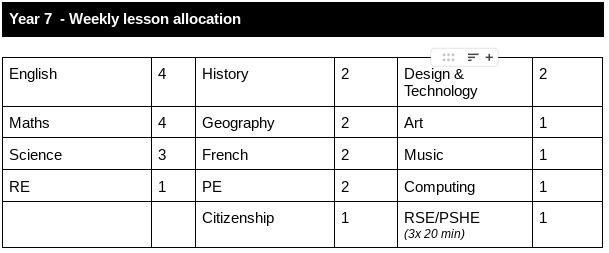
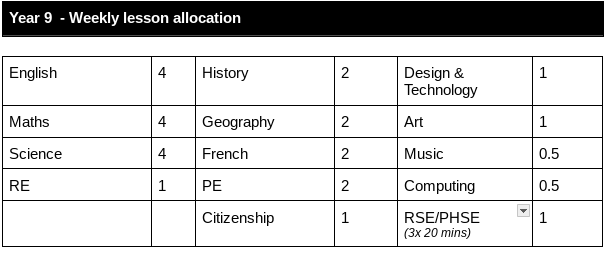
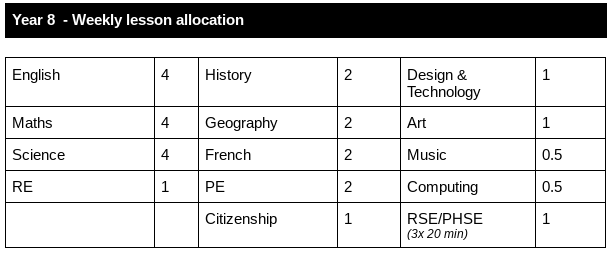
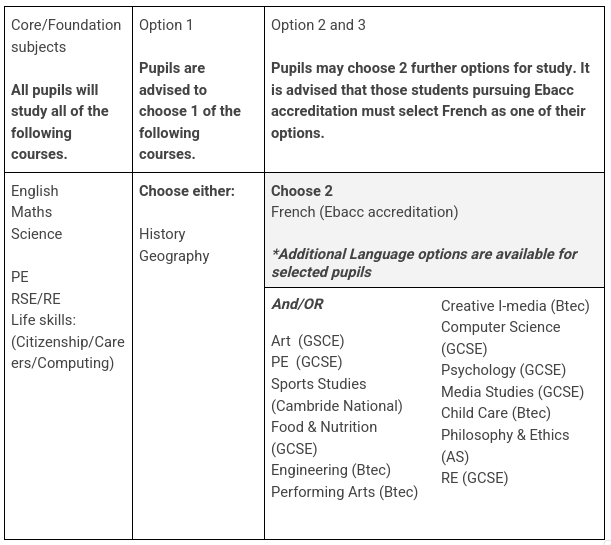
Year 9 Option Choices – Preparing for KS4
It is our intention that a significant number of pupils will follow a curriculum that will include all Ebacc subjects and that pupils have access to a broad and balanced curriculum. Therefore, the options choices are structured around encouraging a language choice and a humanities choice before a wider subject choice is offered to pupils. All pupils will study a core curriculum which consists of:
- English
- Mathematics
- Science (EITHER separate sciences of Biology, Physics and Chemistry OR Combined Science)
- PE
- RE/RSE
- Citizenship
At the end of the Spring term in Year 9, with support from teachers and parents, pupils will make their options choices. All final options choices will be reviewed and assessed and any specific guidance and support for individuals will be provided. We are committed to ensuring that pupils receive excellent information and guidance and that where appropriate, clear signposting and bespoke packages will support the needs of each individual child.
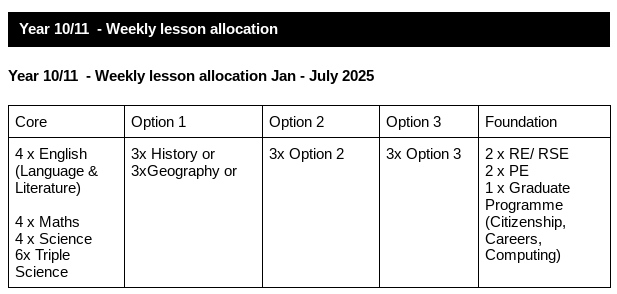
Pupil Options Choices are below:
KS4 Curriculum – Year 10 & 11
The majority of pupils are guided towards a pathway which is most suited to their academic ability and which provides a breadth of study and equips them well for applying for post-16 study or suitable employment pathways. This gives pupils access to the suite of GCSE and Btec subjects that make up the English Baccalaureate measure; English, Maths, two Sciences, a Modern Foreign Language, and Geography or History. We recognise the importance of this combination of subjects and its influence with post-16 providers and the foundation it provides for further and higher education.
We also offer a range of vocational courses at KS4. With the rise of Vocational Education Training (VET) at post 16, along with an increased uptake in young people pursuing apprenticeship courses in evolving industries, we want to ensure that our pupils can also pursue pathways with more practical, skills based elements which prepare them for entry into the workforce earlier than traditional academic pathways.
Some pupils, for whom the Ebacc pathway is not entirely appropriate, will have a bespoke curriculum, that in a very small number of cases, may involve a reduced number of subjects studied and qualifications achieved, possibly including some non-GCSE choices for core subjects and options choices.
We aim to provide the best possible curriculum for all pupils and work tirelessly to ensure pathways lead individuals to personal achievement and success. The KS4 option choices are reviewed annually to ensure they remain engaging and suitable for each cohort and importantly, keep up to date with the full range of GCSE and vocational qualifications available from examining bodies.
The Graduate Programme: Citizenship, Careers and Computing
Using the Gatsby Benchmarks as a framework for good careers guidance, our CEIAG is offered as part of our ongoing ‘Graduate Programme’. As a school we also offer a wide range of experiences, including days throughout the year dedicated for pupils to engage in careers development, jobs and skills work, post 16 pathways, and work experience. Our Graduate Programme offers a range of life skills and substantive knowledge of topics including politics, parliament, power and the law. Pupils explore human rights, justice, equality, the economy, communities and the UK’s role in the wider world. They learn to use and apply their knowledge as they develop capacities to be informed, responsible and active citizens. Pupils also continue their digital education, using Google workspace and IT tools to fully immerse and prepare themselves for the technological demands of the future.